

Why Drip Irrigation Is the Best Choice for West Texas Flower Beds
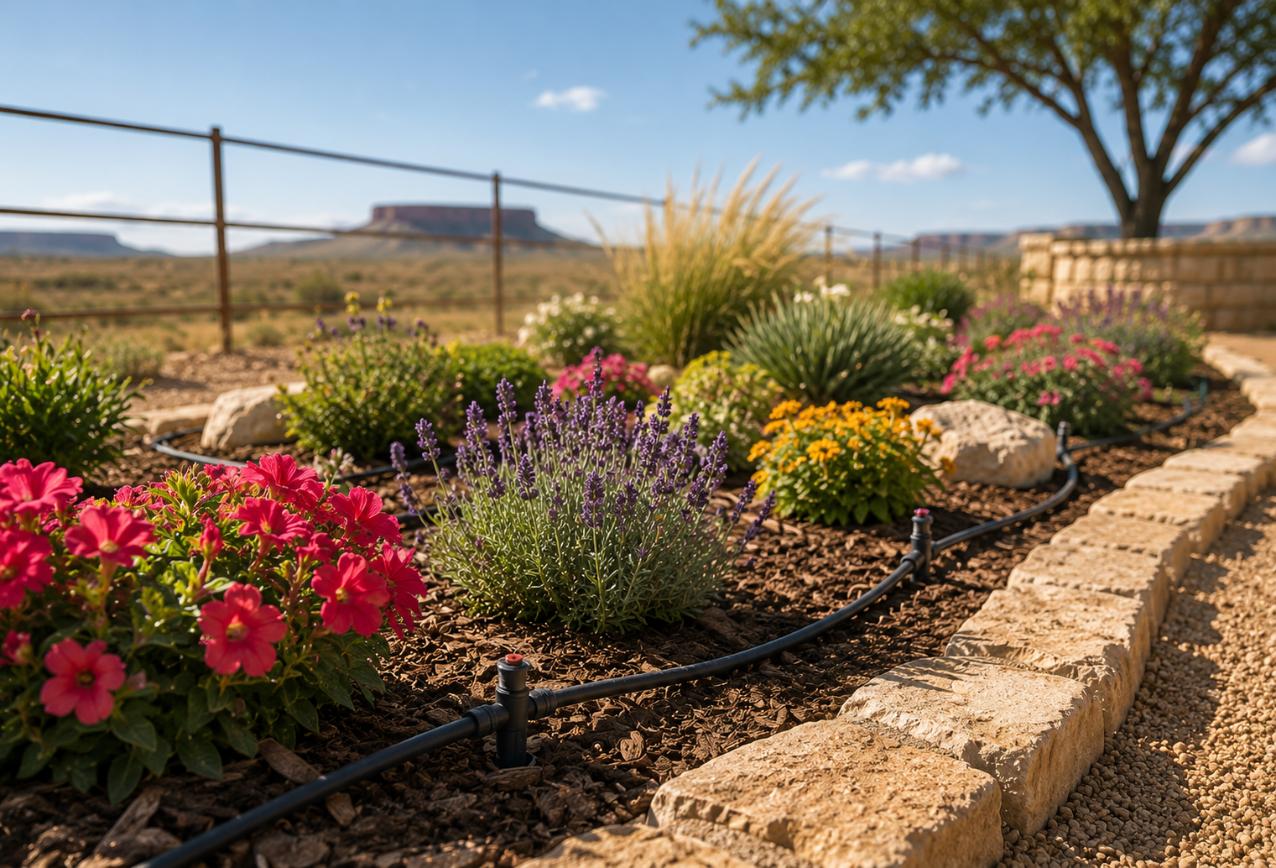
West Texas flower beds face a demanding combination of intense sun, hot summer temperatures, drying winds, and the challenge of putting water exactly where plants need it. In Lubbock, an irrigation method that sprays water across an entire bed can lose some of its usefulness before moisture ever reaches plant roots.
Drip irrigation is often the best choice for West Texas flower beds because it delivers water slowly and directly into the root zone. That targeted approach can reduce unnecessary watering of sidewalks, mulch, and open soil while giving flowers, shrubs, and ornamental plants more consistent access to moisture. For Lubbock property owners, it is a practical way to make landscape watering more precise.
What local readers should know
-
Drip irrigation applies water close to plant roots instead of spraying an entire flower bed.
-
Lubbock’s hot, dry, and windy conditions make targeted watering especially useful during the growing season.
-
Properly placed drip lines can serve individual plants without regularly wetting nearby pavement or large areas of bare soil.
-
Different plants may have different watering needs, so drip irrigation should be designed around the actual flower bed rather than installed with one uniform layout.
-
Routine inspections help catch clogged emitters, damaged tubing, leaks, and coverage problems before plants become stressed.
Why Does Drip Irrigation Make Sense for Lubbock Flower Beds?
Drip irrigation makes sense for Lubbock flower beds because it puts water near the roots while limiting the broad surface application associated with spray irrigation. In a region where summer heat, strong sun, and wind can quickly dry exposed areas, delivering moisture directly to planted zones gives property owners greater control over landscape watering.
West Texas conditions are a major part of that equation. The South Plains are known for an open, windy environment, and landscaped properties around Lubbock County often include beds exposed to significant afternoon sun.
Properties near Texas Tech University, around South Lubbock, or in established areas such as Tech Terrace may have very different bed sizes and plant combinations. Newer landscapes toward Wolfforth can present different layouts again. The irrigation system needs to fit those individual conditions rather than treating every planting area the same.
Jet Landscape And Irrigation works with landscapes in the Lubbock area, and we understand why irrigation design needs to account for local growing conditions as well as the plants being watered.
What Do Local Conditions Tell Us About Flower Bed Irrigation?
Local conditions show that flower bed irrigation in West Texas should focus on controlled water placement and regular system monitoring. Hot weather, drying wind, intense sunlight, and periods of limited rainfall can place ornamental plants under moisture stress, particularly when irrigation does not adequately reach their root zones.
The National Weather Service describes the Lubbock region as having a semi-arid climate. That regional climate is an important consideration when choosing how to water ornamental landscapes.
In practical terms, a flower bed on an exposed south or west side of a home may behave differently from a shaded bed near the structure. Wind exposure, plant maturity, mulch depth, soil conditions, and emitter placement can all affect how quickly the root zone dries.
How Does Drip Irrigation Affect Local Landscapes?
Drip irrigation can help local landscapes receive water more precisely by concentrating irrigation around planted areas instead of broadly spraying the surrounding surface. For Lubbock homeowners, that can mean fewer overspray problems and better control over which sections of a flower bed receive water.
Precision becomes especially helpful in mixed beds. A landscape may contain flowering plants, ornamental grasses, shrubs, and young plantings within a relatively small area. Those plants do not necessarily need identical watering patterns.
A properly planned drip layout can account for plant location and root zones. As landscaping matures, the system can also be evaluated to determine whether emitter placement and watering schedules still fit the bed.
What Are the Warning Signs of a Drip Irrigation Problem?
Warning signs of a drip irrigation problem include unexpectedly dry plants, excessively wet areas, visible leaks, uneven growth, and emitters that no longer release water correctly. Checking flower beds regularly during Lubbock’s hottest months can help property owners identify irrigation problems before prolonged water stress affects the landscape.
Watch for these signs:
-
One plant wilts while nearby plants remain adequately watered.
-
A section of tubing is cracked, cut, disconnected, or exposed.
-
Water pools around one emitter or connection.
-
An emitter appears clogged or produces noticeably less water than nearby emitters.
-
Mulch is consistently soaked in one spot but dry around another plant.
-
Water runs beyond the flower bed and onto sidewalks or other hard surfaces.
-
Plants at the end of a drip zone appear to receive different coverage than plants closer to the supply line.
When Should You Call an Irrigation Professional?
You should call an irrigation professional when flower bed watering remains uneven after basic visual checks, leaks are difficult to locate, multiple emitters are failing, or the existing system does not match the current landscape. Professional evaluation is also useful when adding beds, changing plants, or converting a spray zone to drip irrigation.
Homeowners can safely look for obvious disconnected tubing, observe whether emitters are operating, and watch the soil during a watering cycle. Problems involving valves, pressure, zone design, buried lines, controllers, or larger system changes deserve a closer evaluation.
This is particularly useful before peak summer conditions arrive on the South Plains, when an unnoticed coverage problem can become more apparent as plants require dependable watering.
What Commonly Causes Drip Irrigation Problems in West Texas?
Common drip irrigation problems in West Texas include clogged emitters, damaged or displaced tubing, poor emitter placement, incorrect scheduling, and systems that have not been adjusted as landscaping changes. Local heat, sun exposure, wind, soil conditions, and routine landscape work can make these problems more noticeable over time.
The most common issues include:
-
Emitter problems: Small drip components can become clogged or damaged, reducing water delivery to individual plants.
-
Tubing damage: Yard work, animals, weather exposure, or normal landscape activity can damage accessible tubing.
-
Poor placement: An emitter that once served a young plant may no longer be ideally positioned as the root zone expands.
-
Improper scheduling: Running a drip system like a spray system may not provide the intended watering pattern.
-
Landscape changes: New shrubs, replaced flowers, expanded beds, and changes to mulch can alter irrigation needs.
How Should Drip Irrigation Be Maintained in Lubbock?
Drip irrigation in Lubbock should be maintained through routine visual inspections, seasonal schedule adjustments, emitter checks, and repairs to damaged tubing or fittings. Because West Texas weather changes substantially through the year, the system should not simply run on the same schedule regardless of temperature, rainfall, plant growth, or season.
Turn the zone on periodically and observe it rather than assuming every emitter is working. Look beneath mulch where appropriate, check for unusually wet or dry spots, and verify that water is reaching the intended root areas.
Spring is a useful time to inspect the system before hotter weather. During summer, continue watching plants and soil conditions. As temperatures cool, reevaluate irrigation needs rather than automatically maintaining peak-season watering.
DIY inspection is useful for visible problems. Changes involving pressure, valves, zone configuration, or system redesign are better handled professionally.
What Results Can You Expect From a Properly Designed Drip System?
A properly designed drip system should provide controlled, targeted watering throughout a flower bed while minimizing unnecessary spray outside the planted area. Results depend on correct design, installation, scheduling, soil conditions, plant needs, and ongoing maintenance, so drip irrigation should be treated as a managed system rather than a set-it-and-forget-it solution.
For area homeowners, the most noticeable benefit may simply be greater control. Water can be directed toward plants instead of being broadcast across an entire area.
That does not eliminate the need to monitor the landscape. Plants grow, emitters age, tubing can move, and weather conditions change. Periodic adjustments help the system continue serving the flower bed effectively.
What Mistakes Should Lubbock Homeowners Avoid?
Lubbock homeowners should avoid assuming that every plant needs the same drip layout, burying problems under mulch without checking the system, and setting an irrigation schedule that never changes. These mistakes can create uneven watering and make leaks or clogged emitters harder to recognize.
Mistake: Using identical emitter placement for every plant.
Consequence: Some root zones may receive more or less water than they need.
Better approach: Design water placement around plant type, size, location, and growing conditions.
Mistake: Covering the system and forgetting about it.
Consequence: A leak or disconnected line can remain unnoticed.
Better approach: Run and visually inspect the zone periodically.
Mistake: Never adjusting the controller.
Consequence: Watering may not reflect changing West Texas weather.
Better approach: Review schedules as seasons and landscape conditions change.
Mistake: Adding plants without considering irrigation.
Consequence: New landscaping may sit outside the effective watering area.
Better approach: Update the drip layout whenever the flower bed changes.
What Is a Common Local Drip Irrigation Scenario?
A common local scenario is a Lubbock flower bed that contains established shrubs along with smaller seasonal or ornamental plants, all exposed to different amounts of sunlight. A single spray pattern may water pavement, mulch, foliage, and open areas while still failing to target every root zone effectively.
A drip layout can instead be planned around where plants are actually growing. Established shrubs can receive water at appropriate locations around their root areas, while smaller plants can be served according to the bed design.
As those plants mature or are replaced, the system should be inspected and adjusted. This is a common maintenance need, not a one-time installation consideration.
Which Irrigation Services Can Help?
Irrigation services can help by evaluating existing flower bed coverage, identifying leaks or malfunctioning components, modifying zones, and designing drip irrigation around the current landscape. For West Texas properties, the goal should be a system that matches the planting layout and can be maintained as seasonal conditions and landscaping change.
We can evaluate whether an existing irrigation setup is serving a flower bed effectively and identify areas where adjustments may be appropriate. That may involve repairing a drip line, correcting coverage, modifying components, or considering a different irrigation approach for the bed.
How Does Drip Irrigation Compare With Spray Irrigation for Flower Beds?
Drip irrigation generally offers more targeted root-zone watering for flower beds, while spray irrigation distributes water over a broader surface area. In exposed West Texas beds, drip is often the more practical option when the goal is to water individual plants without regularly spraying nearby pavement, structures, or unplanted areas.
Spray irrigation can still have appropriate landscape applications. The right choice depends on what is being watered and how the zone is designed.
For densely planted ornamental beds, drip can provide useful precision. For other landscape areas, a different irrigation method may make more sense. A professional assessment can determine whether conversion, repair, or modification is appropriate instead of assuming every zone should use the same equipment.
Where Can Drip Irrigation Be Used Around the Lubbock Area?
Drip irrigation can be useful for flower beds and ornamental planting areas throughout Lubbock and surrounding South Plains communities where targeted watering fits the landscape design. Properties in nearby Wolfforth and other parts of Lubbock County can face many of the same regional heat, sun, and wind considerations.
The specific layout should still be based on the individual property, plant material, exposure, and existing irrigation system.
What Can Happen If Flower Bed Irrigation Problems Are Ignored?
Ignoring flower bed irrigation problems can lead to prolonged dry areas, excessive watering in other spots, plant stress, wasted water, and damage that becomes more difficult to correct later. During hot West Texas weather, a failed emitter or broken connection may become especially noticeable because plants depend on consistent access to moisture.
A small drip problem does not automatically require major work. However, identifying it early usually gives the property owner more options. Regular observation can reveal whether the issue is an individual component or a broader design, pressure, or coverage problem.
Frequently Asked Questions About Drip Irrigation in West Texas
Is drip irrigation good for flower beds in Lubbock?
Yes, drip irrigation is well suited to many Lubbock flower beds because it delivers water close to plant root zones instead of broadly spraying the entire surface. That targeted application is particularly useful in the hot, dry, and often windy conditions found across the South Plains.
Does West Texas wind affect flower bed irrigation?
Yes, West Texas wind can affect irrigation methods that send water through the air because wind can alter where spray lands. Drip irrigation releases water at or near the soil surface, making water placement less dependent on an airborne spray pattern in exposed landscape beds.
Can drip irrigation work with mulch?
Yes, drip irrigation can work with mulched flower beds when the system is installed and maintained appropriately. Homeowners should still inspect beneath or around mulch periodically because covering tubing can make leaks, disconnected fittings, or poorly positioned emitters less obvious during routine visual checks.
How often should drip irrigation run in Lubbock?
There is no single correct schedule for every Lubbock drip system. Watering frequency and duration depend on plants, soil, emitter output, sun exposure, weather, season, and system design. Monitor the root zone and plant condition, then adjust the schedule rather than relying on a universal runtime.
Should I use drip irrigation for shrubs as well as flowers?
Drip irrigation can serve both shrubs and flowers when emitter selection and placement account for their different root zones and watering needs. Larger, established shrubs may require a different arrangement than small ornamental plants, so the system should reflect what is actually planted in the bed.
Can an existing spray flower bed be converted to drip irrigation?
An existing spray zone may be able to be modified for drip irrigation, but the correct approach depends on the existing system, pressure, zone configuration, and landscape design. A professional inspection can determine what modifications are appropriate instead of simply attaching drip components without considering how the complete zone operates.
When should I inspect drip irrigation before a Lubbock summer?
Spring is a practical time to inspect a drip system before Lubbock’s hottest weather becomes established. Run each applicable zone, look for leaks, check whether emitters are operating, and confirm that water reaches current root zones. Continue monitoring throughout summer because damage or clogging can occur later.
Is drip irrigation maintenance difficult?
Routine drip irrigation monitoring is generally straightforward because homeowners can visually check exposed tubing, fittings, wet areas, and emitter operation. Troubleshooting pressure problems, buried components, valves, or larger coverage issues can be more complex and may require professional irrigation service.
Help Your West Texas Flower Beds Get Water Where It Matters
A well-planned drip system can give West Texas property owners more control over flower bed watering while addressing the realities of local heat, sun, wind, and changing seasonal conditions. Jet Landscape And Irrigation can help evaluate irrigation needs and determine an appropriate solution for your landscape.
Get Better Flower Bed Irrigation in Lubbock
Give your landscape a watering system designed around the plants and conditions on your property. We can help you explore practical drip irrigation options for your flower beds.